
Over the years, Call Me by Your Name has inspired countless reactions, but one response stands apart even among the many letters André Aciman has received. It arrived anonymously, with no return address and no expectation of a reply. A single page, written by hand, meant only to be read.
Aciman has described it as one of the strangest and most moving forms of communication he has ever encountered. The letter asked for nothing, promised nothing, and seemed almost prepared to be discarded after a quick glance.
“It asks nothing but to be read, promises nothing but to share a few facts and feelings.”
Instead of throwing it away, Aciman kept it. He has kept it for more than ten years.

What struck him was not only the directness of the writing, but the restraint behind it. The letter carried no dramatic gestures, no emotional excess. It felt urgent, as if there was no time for anything more than the bare truth.
“There wasn’t enough time for more — no smarmy pieties, no hand-wringing.”
The handwriting was uneven, but the language was precise. Aciman sensed that the writer knew exactly what he was doing. Writing by hand may have been a way to avoid leaving digital traces, or perhaps a way to make sure the letter would never invite a response. In fact, it wasn’t even sent directly to Aciman. It was first mailed to a journalist in the Bay Area who had mentioned the novel, and only later forwarded to him.
It became clear that the letter’s purpose was simple: to finally say something that had remained unspoken for decades.
“My book had spoken to him. His letter spoke to me.”
The letter was dated April 16, 2008.
“I Was Elio”
The writer explained that he had come across Aciman’s novel during a business trip. It wasn’t the kind of book he would normally read, but he bought it for the flight home. In the end, he was glad he did.
“You see, I was Elio. I was 18 and my Oliver was 22.”
Although the circumstances were different, the emotions felt painfully familiar to him: the uncertainty, the hope, the constant questioning of whether love was real or imagined.
“Mr Aciman got it right.”
One moment in particular affected him deeply — the morning after Elio and Oliver’s first night together. The guilt, fear, and self-loathing felt so close to his own experience that he had to stop reading for a while.
Still, he finished the book before the plane landed. That mattered, because he could not take it home with him.
Unlike Elio, his life followed a different path. He married, had children, and lived what he described as a parallel existence. His Oliver, a man named Dwight, died of AIDS in 1995.
“My name is not important,” he wrote.
And yet, through the letter, fragments of his life emerge. He traveled for work, lived in or near the Bay Area, and had spent years carrying a love that could never fully exist in the open. The rest remains unknown — and was likely meant to stay that way.
Why the Letter Matters
Aciman has reflected on how much — and how little — the letter reveals. Writing had served its purpose. It allowed the writer to give shape to something that had lived only inside him.
That impulse, Aciman suggests, is at the heart of why people write at all.
Over the years, many others have reached out to him after reading or seeing Call Me by Your Name. Some wanted to meet him. Others shared secrets they had never spoken aloud. Some called him unexpectedly, only to apologise and then break down in tears.
“Many were closeted, others totally out.”
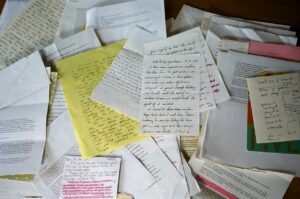
There were widowers who felt a sudden return of hope, young readers searching for their own Oliver, and older men remembering loves that had never been acknowledged. Priests, adolescents, prisoners — all carried versions of what Aciman calls a parallel life.
In that parallel life, things unfold differently. Elio and Oliver stay together. Nothing needs to be hidden. And for a brief moment, through a book or a letter, that life feels real.
Pics: Matthew Leifheit