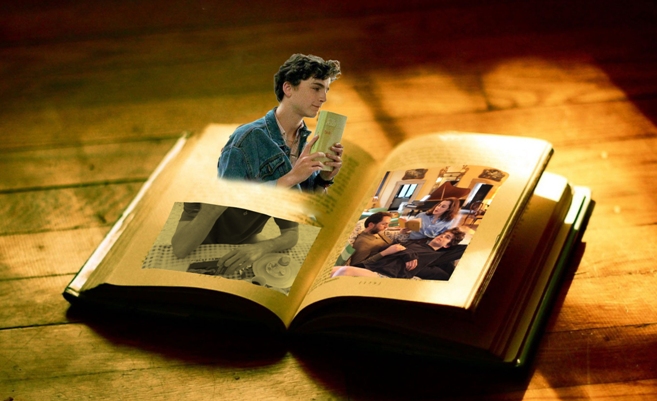
In Call Me by Your Name, objects are never just background details. Books, music, and small everyday items mirror what the characters are going through, often saying what they themselves cannot. These cultural props help shape the emotional world of the film and bring us closer to the inner lives of its characters.
Again and again, the story returns to three closely connected ideas: duality, hiding, and desire. Rather than being explained outright, they surface through what the characters read, listen to, or hold in their hands.
The Dichotomy
One of the most recurring visual motifs in the film is reading. Characters are often shown with books in their hands, and these moments are never accidental. The books reflect their inner conflicts, uncertainties, and unspoken questions.
In one scene, Oliver is seen reading Armance by Stendhal — a novel also mentioned by André Aciman in his book. Armance tells the story of Octave, a young man who falls in love with his cousin. Much like Call Me by Your Name, the novel revolves around inner division and unresolved identity.
The story of Armance itself carries layers of tension. Stendhal originally named his protagonist Olivier, but later changed the name on his publisher’s advice to avoid reviving earlier controversies. Octave becomes impotent after a serious accident, and many readers have interpreted this impotence as a coded way of addressing his homosexuality.
For André Aciman, Armance is one of his favourite novels. Its presence in the film goes beyond a literary reference. After Elio and Oliver’s first night together, Oliver is shown reading the book while quietly questioning what Elio feels — and whether he himself has misunderstood the moment they shared.
As Tommaso Mozzati notes:
“The hero of the book, Octave, is described by Stendhal as an impotent, from both the point of view of his temper (he is a man without any self-control) and of his sexual impuissance. Therefore, the presence of Armance in the movie can be considered a counterpoint for the chaste erotic scenes that precede its appearance, throwing a different light on them.”

The Theme of Hiding
Alongside duality, hiding is another quiet but persistent theme in the film. It appears most clearly during the scene in which Elio’s mother, Annella, reads aloud from The Heptameron, a collection of stories written by Marguerite de Navarre.
The tales in The Heptameron revolve around love, desire, secrecy, and betrayal. As Annella reads, Elio rests his head in her lap, listening to the story of a knight and a princess.
She tells him:
“A handsome young knight is madly in love with a princess. And she, too, is in love with him, though she seems not to be entirely aware of it. Despite the friendship that blossoms between them, the young knight becomes so humbled and speechless that he is unable to confess his love. Until one day he asks the princess directly: ‘Is it better to speak or to die?’”
The parallel hardly needs explanation. Elio is the knight, caught between feeling and fear, while Oliver becomes the distant figure whose response remains uncertain.

Desire and Sexuality
Desire and self-discovery surface again through books when Marzia asks Elio why he reads so much, suggesting that people who read often hide who they really are. Elio turns the question back on her, asking whether she is hiding something from him.
Marzia admits that she has been reading the poems of Antonia Pozzi — a book Elio had given her.
Antonia Pozzi is considered one of Italy’s most important poets. As a young student, she fell in love with her Latin and Greek teacher, who was eighteen years older and returned her feelings. The relationship, however, was never allowed to unfold freely.
Pozzi’s father strongly opposed the relationship, seeing the teacher as socially unsuitable for his daughter. Torn between love and loyalty, Pozzi did not defy him. The relationship ended, and she later attempted suicide. Although her family claimed she died of pneumonia, she passed away shortly after ingesting barbiturates. Different sources record different dates.
Years later, Luca Guadagnino produced a film about the poet, Antonia (2015), directed by Ferdinando Cito Filomarino — another quiet echo connecting literature, desire, and loss.

Books Featured in the Film
-
Pearl S. Buck — Dragon Seed
-
Diabolik (comics)
-
Marguerite de Navarre — The Heptameron
-
Stendhal — Armance
-
Antonia Pozzi — Parole
-
Joseph Conrad — Heart of Darkness
-
Edgar Allan Poe — Selected Writings
-
Heraclitus — The Cosmic Fragments
-
Dacia Maraini — L’età del malessere
-
Ken Follett — Eye of the Needle
-
Michael Korda — Queeney
-
Isaac Asimov — Casebook of the Black Widowers