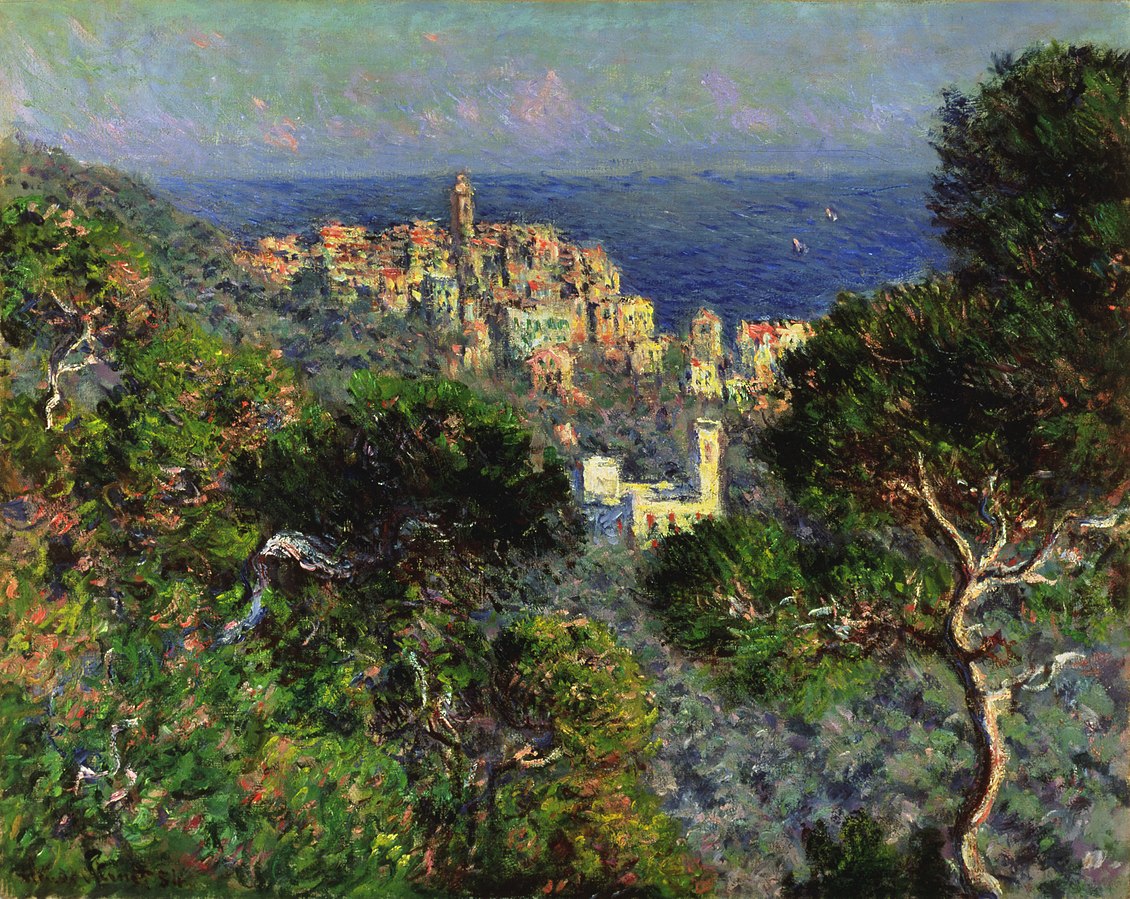
Italy has long been part of the emotional geography of Call Me by Your Name. Readers of Call Me by Your Name by André Aciman know that some of Elio and Oliver’s earliest intimate moments unfold in the hills of Bordighera.
But Elio and Oliver were not the first to be drawn there.
Decades earlier, Claude Monet walked the same terrain, struggling with a different question: how to capture the overwhelming richness of what he saw.
For readers familiar with the novel, the following passage may sound instantly familiar:
“This is my spot. All mine. I come here to read. I can’t tell you the number of books I’ve read here.”
Elio takes Oliver to his secret spot and tells him that Monet used to come there to paint.
We veered off the main road and headed toward the edge of the cliff.
“This,” I said by way of a preface meant to keep his interest alive, “is the spot where Monet came to paint.”
Tiny, stunted palm trees and gnarled olive trees studded the copse. Then through the trees, on an incline leading toward the very edge of the cliff, was a knoll partly shaded by tall marine pines. I leaned my bike against one of the trees, he did the same, and I showed him the way up to the berm.
“Now take a look,” I said, extremely pleased, as if revealing something more eloquent than anything I might say in my favor.
A soundless, quiet cove stood straight below us. Not a sign of civilization anywhere, no home, no jetty, no fishing boats. Farther out, as always, was the belfry of San Giacomo….
“This is my spot. All mine. I come here to read. I can’t tell you the number of books I’ve read here.”
Although the film adaptation relocates the story to Lombardy, director Luca Guadagnino preserves the lush, sun-filled atmosphere associated with Bordighera — an atmosphere deeply connected to Monet’s paintings.
Aciman himself returned to Bordighera repeatedly and wrote about it often. In an interview with GC, he described the pull of the place as something difficult to explain but impossible to resist.
“There are places that sort of beckon you, they beguile you. And you have no idea why, but eventually you just heed the call, and you get off the train without any reservation. And you look for something that you think is there, but you don’t know what it is. Eventually you may find it, but you’re never sure that you have.
I must have been 14 when I first passed by Bordighera. But I didn’t really go there until I was much older: in my mid 30s.”
— André Aciman, interview with GC
Monet first arrived in Bordighera in 1883, at the age of forty-three, traveling along the Mediterranean coast with his friend and fellow painter Auguste Renoir. On their way to Italy, they stopped to visit Paul Cézanne, who was then living near Marseille.
In 1884, Monet returned to Bordighera for what was meant to be a short stay. He remained for nearly three months, devoting himself entirely to painting. During this period, he created a series of three views of the town.
Unlike many artists who focused on the scenery itself, Monet chose to paint primarily the dense vegetation around him. Houses and landscapes appear only occasionally, always as secondary elements. This approach pushed him toward colors he had never used before and left him anxious about whether he could truly capture the place.
He wrote about this struggle to his wife, Alice Hoschedé, describing the difficulty of working among such dense and intricate forms:
“It is extremely difficult to do and it is very time-consuming, mostly because the large self-contained motifs are rare. It is too thick with dense foliage, and all you can find are motifs with lots of detail, jumbles terribly to paint and I, in contrast, am the man of isolated trees and large spaces.”
One detail from the novel creates an unexpected real-world connection. One of the Monet paintings mentioned in Call Me by Your Name is housed at the Hammer Museum — founded by the great-grandfather of Armie Hammer, who played Oliver in the film and later became one of the museum’s honorary board members.
To me, this remains one of the most remarkable coincidences woven into the world of Call Me by Your Name.
Featured image: Claude Monet, View of Bordighera (1884)