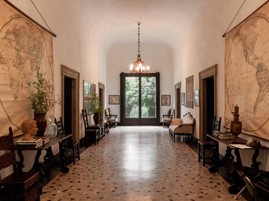
When Call Me by Your Name moved from page to screen, a few choices naturally shaped how the story came across. Luca Guadagnino kept the emotional core intact, but changed the framework around it — shifting the timeline to the early 1980s and placing the story in the Lombardy countryside near Crema.
Those choices are visible on screen. The places feel familiar, settled, and inseparable from the story being told.
Finding the House
Guadagnino’s connection to the villa predated the film itself.
“I love the place and I knew the house,” he explains. “In fact I wanted to buy the house, but I couldn’t afford it. But I knew that I could do something meaningful there, so I made a film instead. Three months before the shoot, I drove my team there and showed them the house and that was it.”
The house would become Villa Albergoni on screen — not merely a backdrop, but a defining presence shaping the rhythm and atmosphere of the story.
Creating the Interior World
Guadagnino worked closely with production designer Samuel Dehors and set designer Violante Visconti di Modrone, whose background lay outside cinema but whose sensibility deeply resonated with the director.
Together, they cultivated an interior world marked by languor, warmth, and intellectual intimacy.
“We created an interior that expressed how this family of intellectuals, of cosmopolitan people, lived in this way.”
The villa was imagined not as a display of wealth, but as a lived-in space rich in memory, culture, and accumulated history.
Drawing Room
Guadagnino envisioned Villa Albergoni as “a place for culture and leisure — not a place for wealth, but a place rich in history.” The drawing room was meant to function as the emotional heart of the Perlman family home.
To soften the room’s original severity, Visconti di Modrone introduced layers of texture and color. Japanese paintings were hung on one of the larger walls, and carpets were added to warm the floor. Sofas and armchairs were upholstered using archival Dedar fabrics, complemented by curtains and tablecloths in similar tones. Decorative objects and curios were sourced from Piva Antiques in Milan.

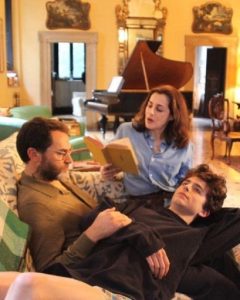
Books were placed throughout the room — deliberately and abundantly.
“Being academia — all anyone does is read in this house.”
At one point in the film, Mrs. Perlman reads aloud from a centuries-old book in German, translating fluidly between German, Italian, and English. Some of the furniture belonged to the villa’s owners and was adapted with green slipcovers. Although the director initially resisted shooting in the room, the set designer ultimately transformed it into a living, breathing space.

Library
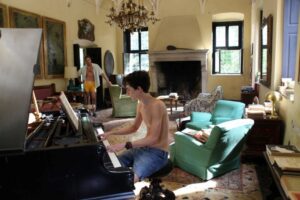
“Every angle of this room is about books,” Guadagnino says of Mr. Perlman’s study.
The faded scarlet sofa came with the house itself. Although it was initially considered too worn, Visconti di Modrone saw its narrative potential.
“Listen, this is perfect — I can see Mr. Perlman passing the time, reading on the sofa.”
The table is scattered with the objects typical of Professor Perlman’s profession: archaeological references, papers, and personal artifacts.

Significant changes were made to the room. The original antique wooden desk was replaced, the mirror was removed, and the red wallpaper behind the sofa was covered with a Dedar brocade. As a subtle homage to Professor Perlman, Visconti di Modrone added antique cameos of Lombard kings, alongside books on Greco-Roman sculpture, antique maps, and a globe.

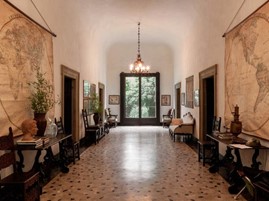
Center Hall
The villa’s entrance had initially felt austere. To bring warmth and movement into the space, Visconti di Modrone hung oversized antique maps sourced from a bookshop in Verona. The corridor was lined with stiff chairs found throughout the house — furniture the Perlmans might plausibly have inherited along with the villa.
Fresh bamboo leaves were always placed in the vases.
“In this corridor, you need to have life. I want the feeling that Mrs. Perlman has gone into the garden and put them there.”
The Garden
The garden was entrusted to landscape designer Gaia Chaillet Giusti. A pergola was constructed, and apricot and peach trees were introduced — neither native to Lombardy, but essential to the film’s seasonal imagery.

“We stuck some real, ripe peaches to the trees, but others were props,” Visconti di Modrone explains.
This was the setting for breakfasts and brunches, with soft-boiled eggs and peach juice served beneath the summer light.
After the Film
After filming concluded, the carefully constructed world of the Perlman family was dismantled.
This is all that remains.

Photos: Giulio Ghirardi
Film stills © Sony Pictures