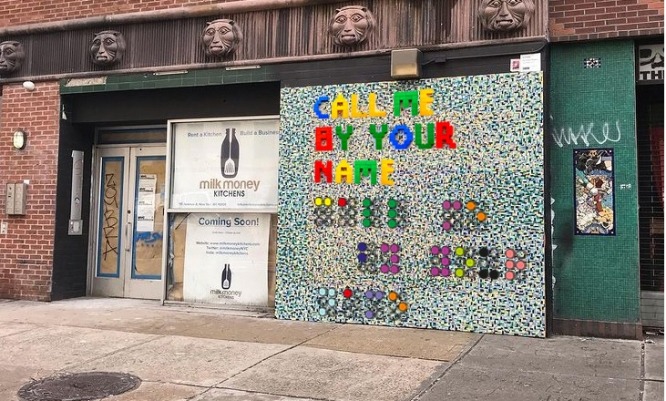
A WorldPride mural in New York
To mark the 50th anniversary of WorldPride and the Stonewall riots, 50 murals were painted on the walls of New York’s Lower East Side in June 2019. Local and international artists were selected to create works across New York City’s five boroughs that reflected and celebrated the beauty, struggles, and activism of the LGBT community.
Among these public artworks was a unique Lego creation by Brooklyn-based artist Jaye Moon. The mural reimagined a scene from Call Me by Your Name in Braille, created in celebration of the WorldPride Festival.
The mural and the film
Instead of showing a familiar image from Call Me by Your Name, the mural works with something more subtle: the film’s words. By turning parts of the script into Braille, the piece feels closely aligned with the way the film itself communicates emotion.
Much of Call Me by Your Name is about what remains unspoken — glances, pauses, moments that only make sense if you pay attention. The mural asks for the same kind of attention. From a distance, it looks like colour and pattern; only up close does it reveal a hidden layer of meaning. In that way, the work doesn’t just reference the film — it reflects how the film feels.
Translating the film into Braille
“As this festival was a celebration of the LGBT community, I decided to use the film Call Me by Your Name to create a wall art piece.
I translated the film’s script into English Braille and built the translation visually using Lego pieces. I edited the film’s script to fit the site-specific space while maintaining the flow of the story. I wanted to draw attention to a language that is often overlooked by people who are not visually impaired.
Using Braille for the script connects several communities in a public space, making the work more intersectional. Viewers may be attracted to the colours of the work and the novelty of the games, but what they actually find in the code are lives that have been historically hidden. The building blocks connect these experiences visually and literally.”